


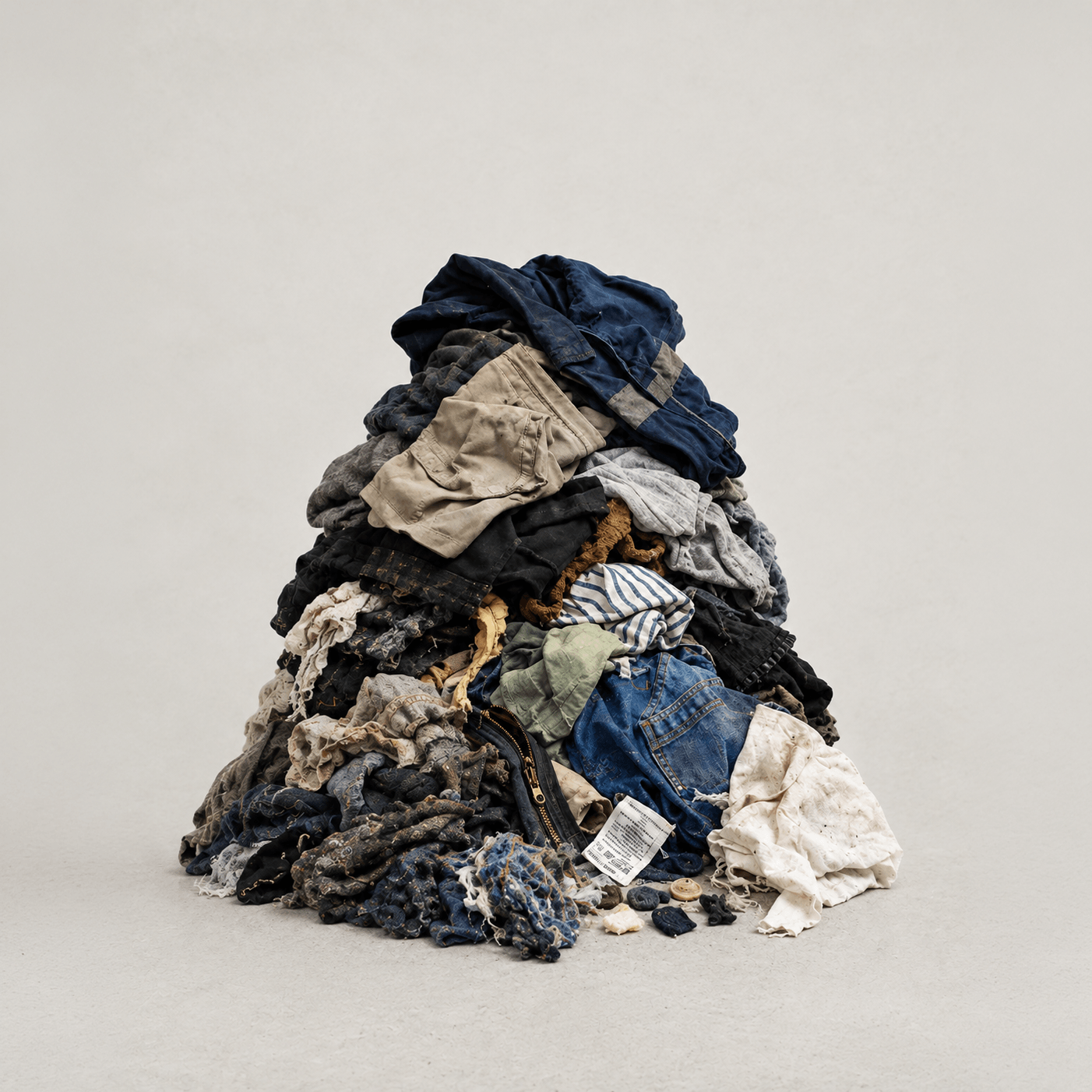
When we talk about waste and recycling, many materials are quickly referred to as resources.
That makes good sense. Sorted cardboard, plastic, metal and steel can, in many cases, be sold on in established markets with known quality requirements, prices and offtakers. In other words, there is an economy around the materials because someone at the other end demands them as raw materials.
But textile waste is a different matter.
Here, it is rarely a question of one clean fraction. Textile waste often consists of mixed fibres, different qualities, colours, buttons, zips, coatings, workwear, rags, industrial textiles and much more. Therefore, the path from waste to a new application is both more expensive and more complicated.
Before textile waste can be given a new life, it typically needs to be collected, sorted, assessed and processed in far more detail than many other waste fractions. Only then do you know what the material can actually be used for.
Some textiles can be reused directly. Some can be recycled into new textiles. But a large share cannot simply be sold on as a sought-after raw material in the same way as cardboard, plastic or metal.
That is an important difference.
Because if we want better solutions for textile waste, we also need to understand the economics of it. Textile waste does not automatically become a resource just because we call it one.
It requires handling, documentation, technology, offtakers and new applications. Until the market is more mature, textile waste will therefore often have a higher handling cost than other waste fractions.
The alternative is cheaper: you can incinerate it.
But if the ambition is genuine circularity, we need to build the solutions and markets that do not yet exist at a sufficiently large scale.
That is where the work lies.