


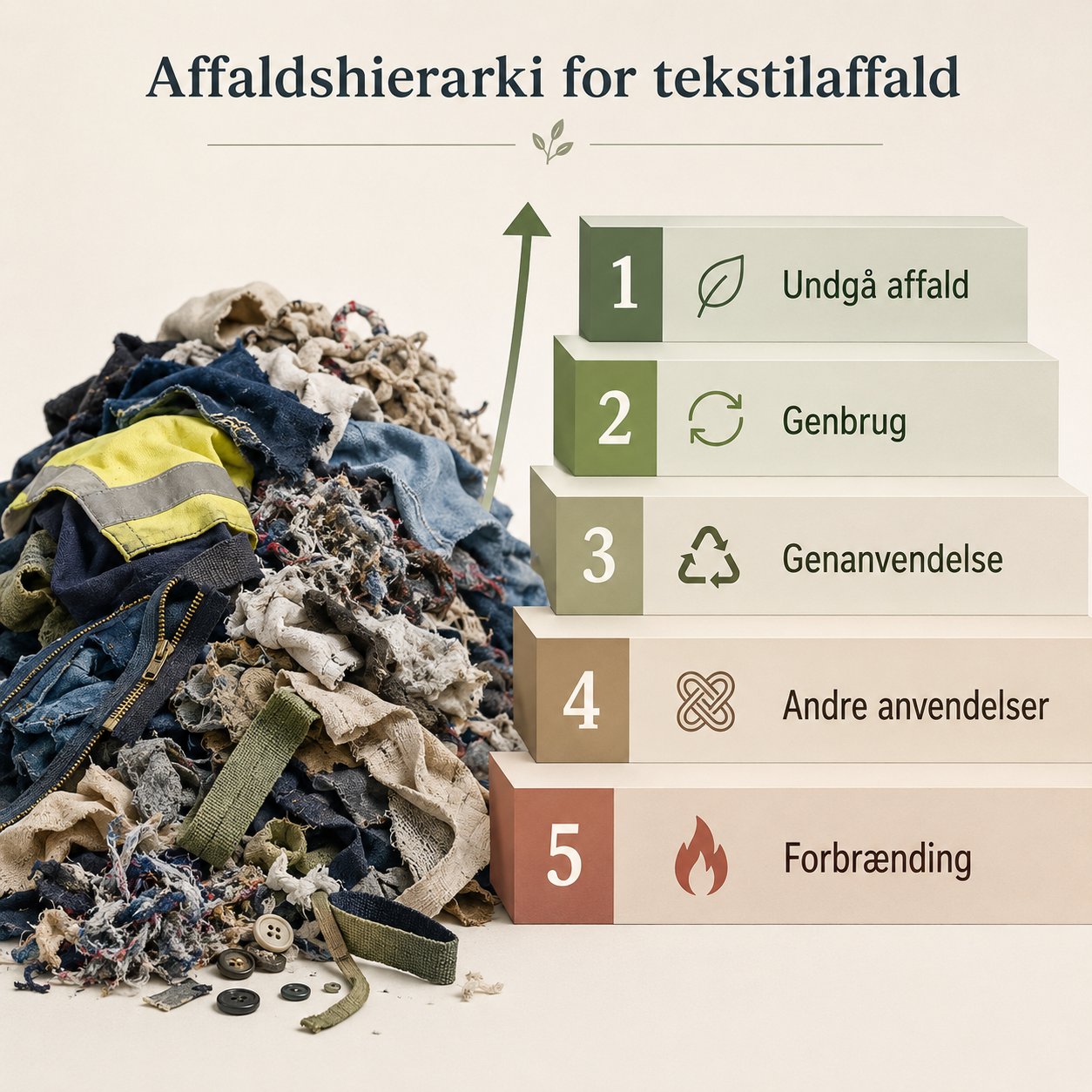
The waste hierarchy is a model that helps prioritise how waste should be managed.
The basic idea is simple: First, we should try to prevent waste from being generated. Next, we should reuse what can still be used. If that is not possible, we should recycle the materials. And only when those options have been exhausted do we end up further down the hierarchy – with energy recovery through incineration.
It is an important way of thinking about waste. Also when it comes to textiles.
The best solution, of course, is that we use fewer textiles, use them for longer and reuse them directly when the quality is good enough. Clothing, textiles and materials that can still be used should, naturally, have as long a service life as possible.
However, textile waste is a complex waste category.
It does not consist only of clothing that can be resold or hung on a hanger in a charity shop. It can also include rags, workwear, industrial textiles, upholstery textiles, blended materials, worn products and textiles with buttons, zips, coatings, prints and other components.
Some can be reused directly.
Some can be recycled into new textiles.
But a large proportion is not suitable for either.
This is where the waste hierarchy becomes particularly relevant. Because the model is not only about choosing the ideal solution. It is also about choosing the best possible solution when the ideal solution is not realistic.
If a textile cannot be reused directly, it should be assessed whether the material can be recycled into new textiles. If that is not possible either, other applications should be considered where the material can have a long and practical life.
Because the alternative is, far too often, incineration.
At Retextil, we work with the part of textile waste where direct reuse or textile-to-textile recycling is not realistic. Instead, the textiles can be incorporated into new materials and applications – including building materials.
This is not about lowering ambitions for textile waste. It is about having ambitions that can also deal with reality.